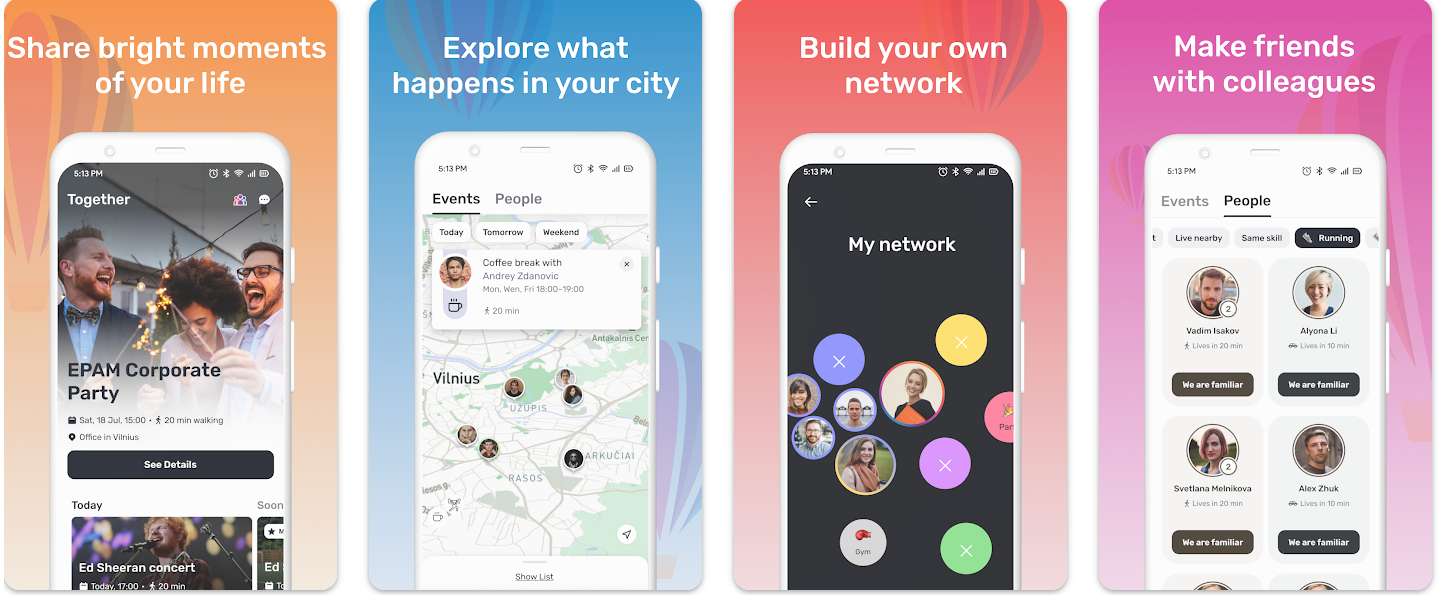
Executive Summary
Together faced a paradox common to fast-scaling social networks: a product designed for global reach that felt foreign everywhere it landed. Users in Canada, the Netherlands, and Italy were installing the app, but not trusting it enough to take the social leap from passive browsing to active engagement.
As the lead researcher, coordinating parallel fieldwork across three markets and mentoring a junior researcher, I designed and executed an 11-week mixed-methods initiative to map the cultural architecture of trust.
The most important shift this research produced wasn’t a new feature, it was a new frame. When initial survey data suggested that adding more privacy controls was the primary solution, interview findings told a different story: users weren’t confused by privacy features, they were confused by defaults. Convincing the Product team to shift direction from “more controls” to “better defaults” required presenting this contradiction directly as the central insight, and it became the strategic foundation for the entire MVP build.
1. The Challenge: When “Global” Means “Foreign Everywhere”
Despite 5,000+ installs on Google Play, Together faced a critical gap: users were arriving, but not trusting the platform enough to interact. Social interaction rates remained critically low, with users abandoning the app before completing a single meaningful peer interaction, creating a stagnant “Engagement Ceiling” that jeopardized long-term growth.
Key Research Questions
- What are the core, region-specific components of Trust across Canada, Netherlands, and Italy?
- What are users’ main Pain Points when interacting with unfamiliar people?
- How do Key Engagement Drivers differ across regions?
- How do users’ actual Privacy Behavior patterns align with product assumptions?
2. Approach: Parallel Mixed-Methods Across Three Markets
Sequential research would have introduced recency bias and made cross-cultural comparability unreliable, parallel execution was a deliberate methodological decision, not a timeline convenience.
A unified protocol was designed with market-specific flexibility. A junior researcher was mentored in executing data collection in one market, with weekly calibration syncs and double-coding of a 15% subset of qualitative data to maintain inter-rater reliability.
Phase 1: Deep Discovery, The “Why”
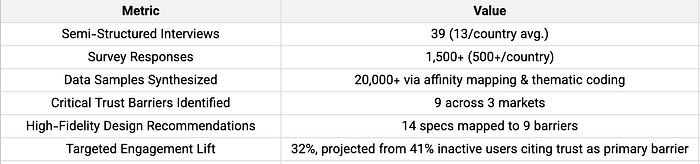
- Semi-Structured Interviews (12–15/country, 39 total) — rich qualitative narratives on trust, risk perception, and privacy behavior, the foundation for understanding the regional mindset.
- Competitive & Cultural Analysis — socio-cultural context and local social network norms to ground findings in regional reality.
Phase 2: Validation & Modeling, The “How Much” and “How To”
- Large-Scale Survey (500+/country, 1,500+ total) — quantifying qualitative themes into statistically defensible feature priorities.
- Trust-Scenario Usability Tests — observing behavior during high-risk interactions (reporting content, changing privacy settings, accepting stranger invites).
- Privacy Mental Model Mapping — synthesizing 20,000+ data points to chart how users think features work vs. how the app was actually designed.
3. Key Findings: Three Markets, One Convergent Failure
Finding 1: “Trust” Means Three Different Things in Three Markets
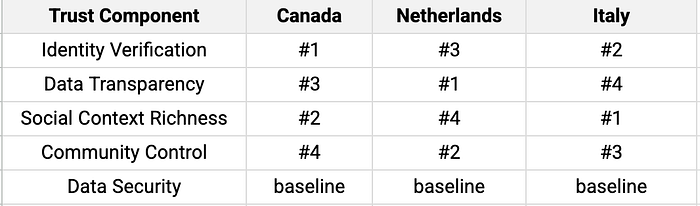
- Netherlands: prioritized data minimization and transparency. Location permission before demonstrated value was the primary trust-breaking moment. Significantly more likely to use nicknames, resisting identity disclosure until value was proven.
- Canada: highest sensitivity to community safety signals. Trust tied to who else is on this platform, not data privacy. Verification signals (profile completeness, mutual connections, event history) mattered more than privacy settings.
- Italy: strongest community-oriented trust model. Least concerned with abstract data privacy, but highly sensitive to how other users’ identities were presented. Anonymous profiles were perceived as suspicious. Trust built through social richness, not privacy guarantees.
Finding 2: The Privacy Paradox, Universal Problem, Three Different Expressions
Users expressed high concern for privacy in interviews, yet in usability tests, the majority left defaults unchanged and shared more than their stated preferences suggested.
- Italy: 74% of users who rated privacy “very important” never adjusted a single setting during testing.
- Netherlands: 41% actively explored privacy settings during onboarding.
This directly invalidated the team’s hypothesis. Users didn’t want more controls, they wanted more clarity about what defaults meant.
Finding 3: Trust Collapsed at the Same Moment, For Three Different Reasons
Journey mapping revealed a convergent failure point: the moment of first interaction with a specific, unfamiliar person.
- Netherlands: I don’t know what data they can see about me right now
- Canada: I don’t know if this person is actually who they say they are
- Italy: I don’t know anything about this person’s social context
Three different questions, one design gap: no contextual trust information at the moment of first contact.
This led directly to the Contextual Trust Card, a lightweight overlay surfacing the right trust signal per market at the moment of first interaction:
- CA: verification badge + shared connections count
- NL: data visibility summary (what they can see about you right now)
- IT: social context snippet (mutual events, shared interests, community membership)
All three variants in one unified component, single engineering implementation with market-configured display logic.
Finding 4: Engagement Drivers, More Similar Than Expected, One Key Divergence
Shared interest was the primary driver in all three markets (4.2–4.6/5). Secondary drivers shaped MVP feature priority:

4. From Insight to Blueprint
The Culturally-Sensitive Privacy Framework
One unified codebase with market-aware defaults, not three separate privacy systems.
“Principle 1: Default to Trust, Not Neutrality — a “neutral” default is never actually neutral. NL default: minimal data sharing, maximum transparency. IT default: rich social visibility, depth-first. CA default: community verification signals foregrounded.”
“Principle 2: Value Before Permission — onboarding redesigned to surface a relevant local event before requesting location, converting the permission request from an abstract data demand into a concrete value exchange.”
“Principle 3: Contextual Clarity Over Granular Control — every trust-sensitive interaction surfaces a one-line plain-language summary: “They can see your first name and city. You can see their full profile.””
“Principle 4: Trust Signals Are Contextual, Not Decorative — verification badges must appear at the moment of trust decision, not only on static profile pages.”
Regional Trust Priority Models
Scope of Responsibility
Full research lifecycle owned end-to-end: protocol design, cross-cultural fieldwork coordination, synthesis, modeling, and final delivery. Responsibility concluded upon sign-off of 14 validated specs and documented A/B test metrics. MVP build and launch managed by Engineering, Product, and Analytics teams.
5. The Roadmap
The 11-week timeline prioritized understanding before measuring, qualitative insight shaped quantitative instrument design throughout.

Conclusion
The most counterintuitive finding: users across all three markets didn’t distrust the platform, they distrusted themselves to make the right privacy decisions within it. The barriers weren’t technical; they were cognitive.
That single insight reframed everything. The solution wasn’t a more complex privacy system, it was a smarter default architecture and a contextual trust layer at the moment of first contact. The Contextual Trust Card, the four Framework principles, and the redesigned onboarding all emerged from this one reframe.
Research that confirms what a team already believes is useful. Research that changes what a team builds is necessary.
Together | Senior UX Researcher | 2024–2025. Markets: Canada · Netherlands · Italy. Timeline: 11 weeks.