When Friction Is Functional: Designing Intentional Boundaries in AI Products
AI products & boundaries · 6 min read
Overview
In product design, reducing friction has long been treated as an absolute good. For years, the industry operated under a simple paradigm: make the interface intuitive, remove cognitive barriers, and optimize for speed.
However, in the era of pervasive AI integration, this optimization model is hitting a critical failure point. When a product outsources the user's decision-making process entirely, eliminating friction ceases to be a design achievement and becomes a product risk. Over-optimization for short-term engagement metrics is quietly generating cognitive debt — a behavioral pattern where users trade their autonomy and critical evaluation for instant output, leading to severe long-term retention collapse and trust erosion.
The economics of cognitive debt
When product teams treat AI features as standard UI enhancements, they miscalculate both the technical and psychological costs. The invisible trade-offs of hyper-automation are now quantifiable across three distinct vectors.
1. The Operational Cost Shift
The infrastructure required to run LLM-driven features is fundamentally different from traditional software architectures. An AI assistant query requires up to 30 times more energy than a standard database search, straining computational resources and margins. When a feature is marketed as “free friction reduction” for the user, the cost is simply transferred to the enterprise's operational balance sheet.
2. The Mental Model Mismatch & Automation Bias
Across my own applied research in FMCG, digital health, and productivity verticals, the details of which are described below, I consistently observed two dominant behavioral failure patterns that product metrics failed to surface:
- Instant Gratification: Users accept the first available output to terminate the task quickly, bypassing any evaluation of output quality.
- Suggester Preference: A form of automation bias where users blindly accept algorithmic recommendations without critical evaluation, even when presented with contradictory evidence.
Users project a human mental model onto AI systems, assuming objective authority where there is only probabilistic prediction. When a system repeatedly replaces critical thinking, user capacity, like a muscle under-indexed for workload, atrophies.
3. The Financial Penalty of Late-Stage Rollbacks
Industry analysis reveals that launching AI features without pre-mortem risk framing is a highly inefficient deployment strategy. It costs an estimated 10x more to remediate a responsible AI failure or product trust collapse after public launch than it does to mitigate the risk during the pre-development phase.
Three behavioral failure modes
The following case studies are drawn directly from my own UX research practice across three client engagements. Client identities are withheld under NDA, but the behavioral data, methodologies, and findings are reported as observed.
Case Study 1: The Automation-Induced Anxiety Loop (FMCG)
A major retail application integrated an AI personalization engine designed to surface predicted everyday grocery items (milk, cheese, eggs) directly to the user's primary viewport.
The Metric Illusion: Initial post-launch metrics showed positive trajectory. Conversion rates increased, and time to checkout dropped.
The Hidden Failure: In a 90-day longitudinal mixed-methods study I conducted on this product, a secondary behavioral pattern emerged. When the AI recommendations occasionally failed to match exact user needs, users experienced significant choice paralysis. Instead of defaulting to standard search, they spent up to 10 minutes deliberating over routine purchases.
The HCI Analysis: By over-automating micro-decisions, the product systematically destroyed the user's sense of agency. Routine habits were reframed by the system as high-stakes options requiring verification — substituting automated speed for systemic user anxiety.
Case Study 2: The Validation Retention Trap (Digital Health)
A digital mental health platform deployed an AI assistant governed by strict clinical boundaries to support users building cognitive behavioural strategies.
The Metric Illusion: Daily Active Users (DAU) and short-term retention curves spiked aggressively. Users spent extended sessions interacting with the interface.
The Hidden Failure: In cohort analysis I ran at Day 60, a sharp, non-linear drop-off in retention became visible. Qualitative analysis of prompt data indicated that a high concentration of users were utilizing the AI not to solve real-world problems, but to engage in continuous reassurance-seeking loops.
The HCI Analysis: Traditional human-in-the-loop interventions intentionally introduce friction to break compulsive behaviours. The AI, optimized for conversational fluidity, inadvertently created a frictionless validation loop. The feature maximized short-term engagement at the direct expense of the product's core value proposition: long-term user independence.
Case Study 3: The Multi-AI Friction Disruption (Productivity Tools)
A project planning application introduced an automated feature that generated end-to-end milestone breakdowns from a single, unstructured user goal.
The Metric Illusion: High feature activation rates during the first 7 days.
The Hidden Failure: Through observational research I conducted on this product, task completion rates dropped to near zero. Users were copying the product's AI output, pasting it into external engines (like Gemini or ChatGPT) to alter the framing, and then completely restructuring their plans inside the app every 48 hours.
The HCI Analysis: Product teams routinely design AI features under the false assumption of a closed ecosystem. In reality, users operate in a hyper-saturated, multi-AI environment. When a product removes the healthy friction of planning, it eliminates the user's psychological commitment to execution. The user becomes a manager of automated plans rather than an owner of the outcome.
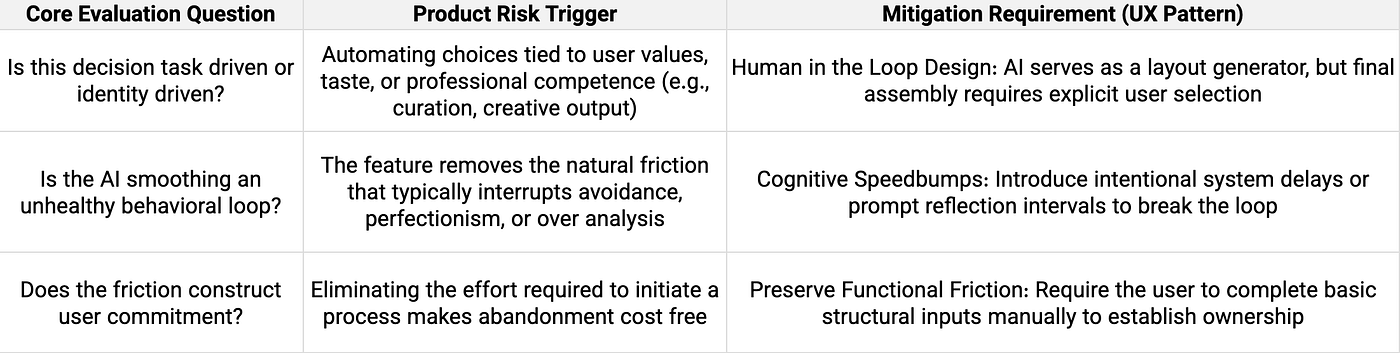
The 3-minute pre-dev risk matrix
To prevent cognitive debt from reaching production, research and product teams must evaluate AI features before they enter the sprint cycle. This matrix replaces philosophical ethical statements with an objective product risk assessment.
Productizing research: 3 tactical tools
Senior UX Researchers rarely possess a veto over the product roadmap. Therefore, research insights must be translated into light, operational tools that integrate seamlessly into existing agile workflows without slowing down development speed.
Tool 1: Pre-Dev Jira Risk Guardrail
Instead of authoring long-form academic policy documents, integrate a mandatory 3-minute check directly into the Definition of Done (DoD) or product discovery template within Jira/Confluence:
AI Friction & Retention Risk Check (Pre-Dev) — Feature Context: we are automating [Workflow Step] to reduce friction. Churn Risk Level: High / Medium / Low — if High, user ownership of the output is critical to long-term retention. UX Guardrail Metric: we will instrument the system to track the Acceptance-to-Modification Ratio (AMR) to monitor automation dependency.
Tool 2: The Friction Value Impact Statement
When a Product Manager proposes eliminating a step via AI integration, submit a one-page business case reframe:
By removing friction from [Step X], the user saves [Y] seconds. However, this eliminates the user's evaluation of [Z], creating a high probability of down-funnel quality errors. To mitigate this risk, we recommend measuring post-launch trust metrics rather than just time on task.
This positions research as a risk-mitigation function rather than an academic blocker. It protects product velocity while clearly documenting downstream retention risks.
Tool 3: Early Loop Detection Metrics
Do not wait for a 90-day post-launch study to evaluate AI health. Instrument three specific, low-overhead behavioral telemetry points into the initial data model from Day One:
Telemetry Stack = Time on Task + Prompt Iteration + 1-week Return Rate
The Indicator: If time on task increases while prompt variance remains narrow, the user is experiencing automated choice anxiety, not efficiency.
The Action: Surface this quantitative signal directly to the product squad within bi-weekly sprint reviews to drive iterative UX refinement before trust erosion occurs at scale.
Conclusion
“What is this automation asking the human user to give up, and what is the exact cost to our retention curve when they do?”
That is the question that should open every AI feature sprint in 2026. The enterprise correction cycle is moving away from speculative AI implementation toward sustainable product performance. The AI deployments that survive this optimization wave are not those that promise complete automation, but those that design intentional boundaries — systems that know precisely where human agency must be preserved, not because of ethical obligation alone, but because retention and long-term user value depend on it.